
Your sleep is off. Your mood is unpredictable. You feel like a stranger in your own body — and nobody seems to have a straight answer for why. Maybe your doctor ran labs and told you everything looks “normal.” Maybe you’ve been Googling your symptoms for months and still can’t make sense of them. Or maybe you just have this nagging feeling that something has shifted, and you’re tired of waiting for someone to take it seriously.
Here’s what I want you to know: your body isn’t broken. It’s communicating. And once you understand what it’s saying, you can actually do something about it.
Menopause isn’t a moment — it’s a three-phase process
Most women don’t realize that “menopause” is actually the name for a single day: the 12-month mark after your last period. Everything leading up to that? That’s perimenopause — and it normally starts in early to mid-40’s, but it can happen much earlier, or even later.
But let’s back up a bit for the full picture:
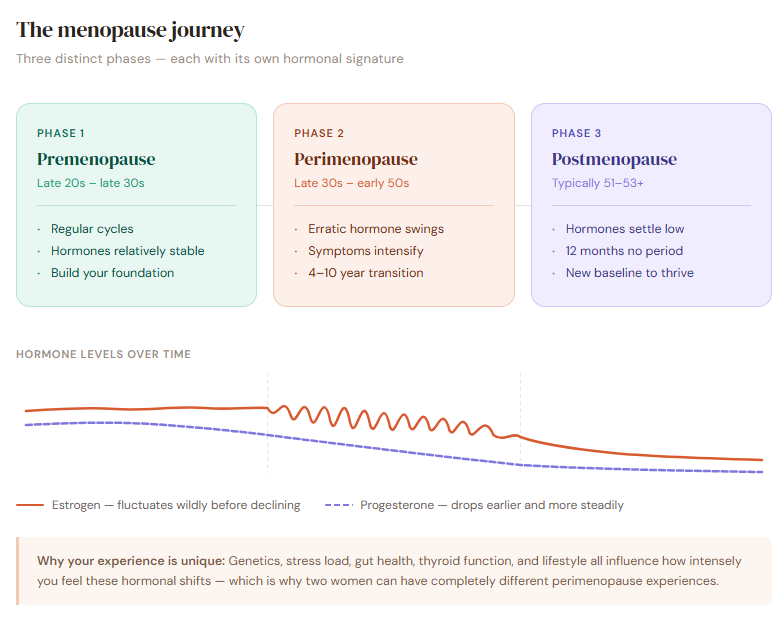
Premenopause — your reproductive years, when cycles (normally) are regular, and hormones are (relatively) stable. This is your window to build the health foundation that will carry you through what’s ahead.
Perimenopause — the transition phase, lasting anywhere from 4 to 10 years. Estrogen and progesterone don’t decline smoothly — they swing. Sometimes wildly. Sometimes daily. That’s why your symptoms can feel random, inconsistent, and hard to address.
Postmenopause — the year-plus after your final period. Hormones settle at a new, lower baseline. This phase comes with its own set of considerations — bone density, cardiovascular health, metabolic shifts — but it’s also where many women feel the most stable and in control, especially with the right support behind them. So, there is light at the end of the tunnel.
Again, where did Menopause go? It is only that one day anniversary of the start of your final cycle. And, unfortunately, it isn’t just a one-day event. Understanding where you are in this process matters. Not so you can slap a label on it, but so you can stop second-guessing yourself and start responding to what your body actually needs. Knowing where you are is not just a simple lab panel, however.
Your lab results aren’t the whole story
“Your labs look normal.” If you’ve heard that and still felt terrible, you’re not imagining things.
Standard hormone panels — estradiol, progesterone, FSH, LH — may give you insight, but is it useful? Perimenopause is characterized by fluctuation, not a steady decline in estrogen. Your estrogen can swing from high to low within the same week. A single blood draw won’t capture that. Just a high FSH alone may be enough for your doctor to decide you are in perimenopause, but then what do you do with that information?
And even if the numbers do show a shift, they don’t explain why you feel exhausted, anxious, foggy, or inflamed. Because hormones don’t operate in isolation. They’re connected to everything:
Your thyroid regulates energy and metabolism — and thyroid dysfunction is frequently missed or undertreated by doctors in perimenopausal women.
Your gut health affects how you detox and metabolize hormones, produce neurotransmitters, and manage inflammation.
Your liver clears spent hormones and toxins — if it’s overburdened, those hormones recirculate and can cause symptoms and toxins can build up.
Your adrenals take over some hormone production as ovarian function declines — which means chronic stress hits differently now than it did ten years ago.
Functional lab testing really shines here —not to replace your GYN, but to fill in the gaps—to find the root causes driving your symptoms so you’re not just managing them; you’re actually resolving them.
Your experience is different from everyone else’s
You might know women who sailed through perimenopause. You might know women who were blindsided by it. Both are normal — and that gap in experience comes down to real, identifiable factors.
Genetics plays a role. So does body composition, stress load, sleep quality, gut health, thyroid function, and how well your detox pathways are running. These aren’t abstract variables — they’re things you can actually influence.
And here’s what often gets missed: the earliest signs of perimenopause frequently have nothing to do with hot flashes. They look like:
- Waking up at 3 a.m. for no obvious reason
- Anxiety that seems to come out of nowhere
- Brain fog that wasn’t there five years ago
- Cycles that are shorter, longer, or just different
- New food sensitivities or digestive changes
- Joint aches or muscle soreness for no apparent reason
These aren’t random. They’re your hormonal and metabolic systems talking to you. And they’re worth listening to.
What actually matters
Honestly, the exact stage you’re in matters less than what’s happening in your body right now.
What I care about — and what makes the difference in how my clients feel — is understanding your symptoms in context. What’s driving them? Which systems are under stress? And what targeted, strategic support will actually move the needle?
You don’t need a perfect label to start feeling better. You need the right information about your body, and a plan built around that.
That’s the difference between chasing a diagnosis and actually healing.
Ready to stop guessing?
If you’re tired of trying to piece this together on your own, grab the Menopause Map — a free resource to help you understand what your symptoms are telling you and where to focus first. Basically, a deeper dive into the process of thriving through perimenopause and postmenopause.
Or if you’re ready to go deeper, book a free 45-Minute Discovery Call. We’ll look at what you’re experiencing, identify what’s likely driving it, and talk through what a personalized functional health approach would look like for you.
You can feel better than you do right now. Let’s figure out how.